Blink 3D: Turning Multiple Phones Into a Shared 3D Capture System
Blink 3D is an experimental Kanverse system that coordinates multiple
Blink 3D: Turning Multiple Phones Into a Shared 3D Capture System
What if several ordinary smartphones could work together as the eyes of a single 3D capture system?
That is the idea behind Blink 3D, an experimental Kanverse project currently in active development.
Instead of requiring a dedicated multi-camera rig, Blink 3D explores whether phones already in people's hands can cooperate in real time to photograph the same object or scene from different viewpoints.
Multi-Phone Capture
A Blink 3D session can connect multiple phones to the same capture experience.
Each participating device can contribute its own camera viewpoint. The prototype coordinates the connected devices so that the creator can see which cameras are ready before initiating the capture.
In our current two-phone prototype, both devices can report ready status and participate in the same capture operation.
Synchronized Capture
Once the participating cameras are ready, the creator can trigger Capture All Cameras.
The connected phones capture their viewpoints as part of the same coordinated capture session.
The system also records timing information for the returned captures, allowing us to inspect how closely the different devices responded.
This is an important part of the experiment because multi-view reconstruction depends not only on having several photographs, but on obtaining useful views of the same scene.
Camera Position Assignment
After capture, Blink 3D allows the viewpoints to be assigned positions such as:
- Left
- Front
- Right
- Other capture positions as the system evolves
This gives the reconstruction process information about how the different photographs relate to the scene.
The current prototype already provides an interface for reviewing the captured camera angles and changing their assigned positions.
Capture Studio
The captured viewpoints are brought together inside the Blink 3D Capture Studio.
Here the creator can inspect the photographs from the participating phones and compare the different perspectives before attempting reconstruction.
This turns what would normally be unrelated photographs on separate devices into parts of one coordinated capture project.
Experimental Depth Engine
Blink 3D also includes an experimental Build 3D stage.
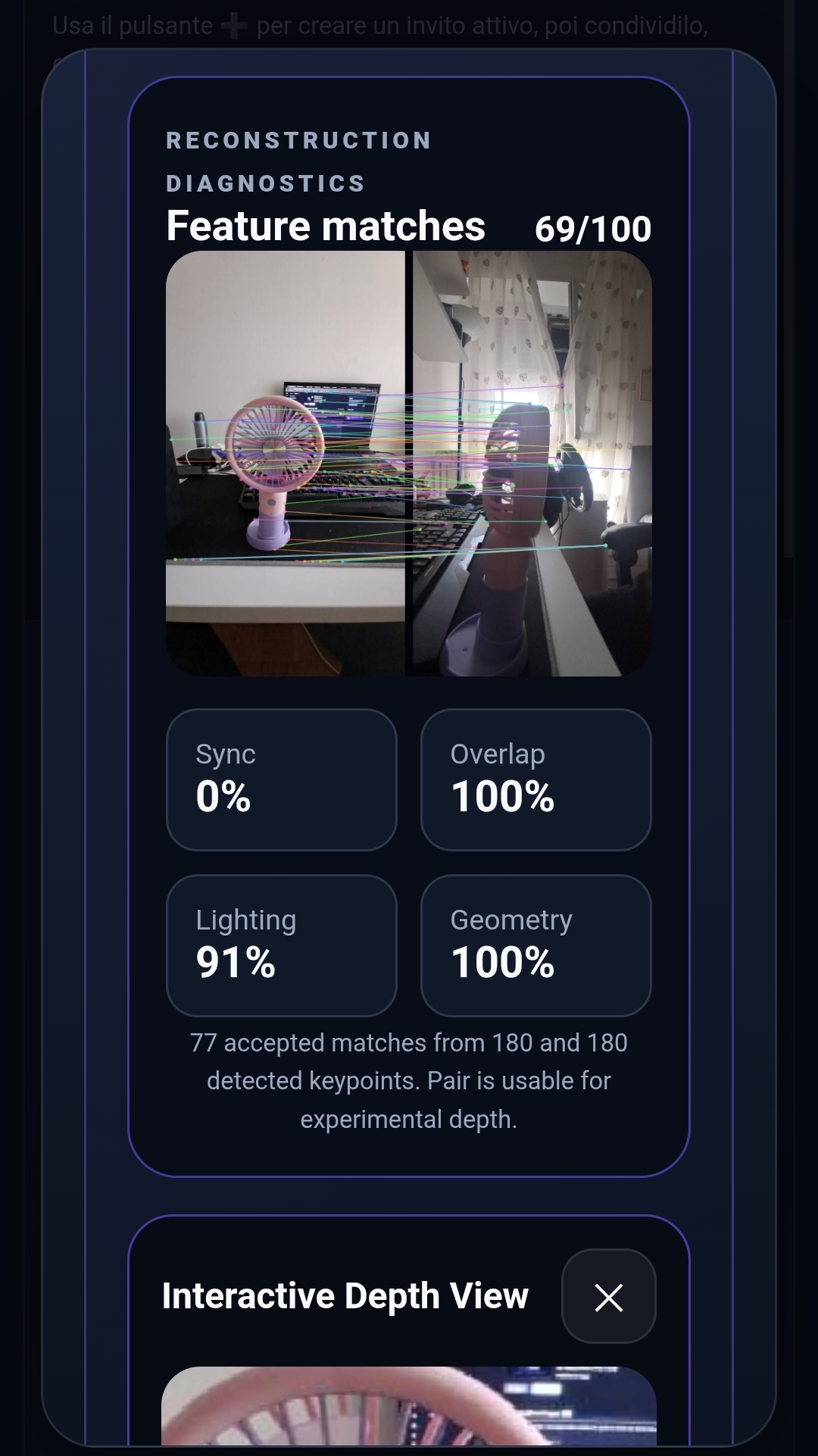
The current research prototype uses assigned synchronized viewpoints to investigate lightweight depth estimation and 3D reconstruction directly from consumer-device images.
This part of Blink 3D remains experimental.
The objective is not simply to display several photographs. The longer-term goal is to determine how much spatial information can be recovered when multiple ordinary phones observe the same real-world subject from different positions.
Local Originals
Blink 3D is also being designed around a lightweight approach to image handling.
Original full-resolution photographs can remain on the phones while network-safe previews are returned to the creator for inspection and coordination.
This architecture is particularly interesting for future distributed capture experiments because participating devices can contribute to a project without requiring every original image to be treated like a conventional centralized photo upload.
What Works Today
The current Blink 3D prototypes demonstrate:
Multi-phone participation
Multiple phones can participate in the same capture workflow.
Camera readiness
The creator can see when participating cameras are ready.
Coordinated capture
The system can request captures from the connected devices.
Multiple viewpoints
Different phones provide different views of the same physical subject.
Camera-position assignment
Captured images can be identified as Left, Front or other viewpoints.
Capture inspection
The resulting camera angles can be viewed and compared.
Experimental 3D pipeline
Captured viewpoints can be passed toward an experimental depth/3D reconstruction stage.
Where Blink 3D Is Going
Blink 3D is not yet presented as a finished consumer 3D scanner.
It is a working research and development project.
Future experiments can investigate more cameras, improved synchronization, better depth estimation, automatic viewpoint detection, image alignment, spatial reconstruction and eventually richer shared 3D environments.
The broader Kanverse vision is to move beyond conventional communication where people simply exchange text, photographs and video.
Blink 3D asks a different question:
Can connected people and their phones collectively capture a place, object or moment as a shared spatial experience?
That is what we are building toward.
Prototype Access
Blink 3D is currently In Development.
Working prototypes are available for demonstration and development discussions with interested developers, collaborators and technology partners.
Interested in Blink 3D? Contact Kanverse.